
Clean water is one of those things most of us take for granted until something changes. Maybe the water starts tasting a little odd. There’s a white film around the taps, soap doesn’t seem to lather properly, or you notice a strange smell when you fill a glass. These small clues can point to bigger water-quality issues.
That’s where a good water treatment system can make a real difference. But choosing one isn’t simply about buying the most expensive filter on the market. Different water problems call for different solutions, and understanding what’s actually in your water is the first step.
Start by Understanding Your Water
Before choosing any filtration equipment, it helps to know where your water comes from and what it contains. Municipal water and private well water can have very different characteristics.
City water is generally treated before it reaches your home, but it may still contain chlorine, sediment, minerals, or other substances picked up along the way. Well water, meanwhile, can contain higher levels of iron, sulfur, hardness minerals, or naturally occurring contaminants.
A basic water test can reveal useful information about hardness, pH, iron, chlorine, total dissolved solids, and other factors. It’s a much smarter starting point than guessing based on taste or appearance.
After all, clear water isn’t automatically perfect water.
Why Whole-Home Filtration Is Worth Considering
If your goal is to improve water throughout the house, home water filtration can be a practical option. Unlike a small filter attached to one faucet, whole-home systems treat water as it enters the property.
That means the water used for drinking, cooking, bathing, laundry, and cleaning receives treatment.
Depending on the system, filtration may target sediment, chlorine, unpleasant odors, or other unwanted substances. This can be especially useful for households where water quality affects more than just the kitchen.
There’s also a comfort factor people sometimes overlook. Better water can mean fewer unpleasant odors during showers, cleaner-looking fixtures, and less sediment making its way into appliances.
It’s not glamorous, sure. But once you get used to it, you notice the difference.
Hard Water Is a Different Problem
Hard water is caused mainly by dissolved calcium and magnesium. These minerals aren’t usually something you can simply remove with a standard sediment filter.
Instead, hard water often calls for a water softener.
Signs of hard water can include scale around faucets, cloudy shower doors, stiff laundry, reduced soap lather, and mineral deposits inside water heaters or plumbing fixtures. Over time, scale buildup can interfere with the efficiency of appliances and plumbing components.
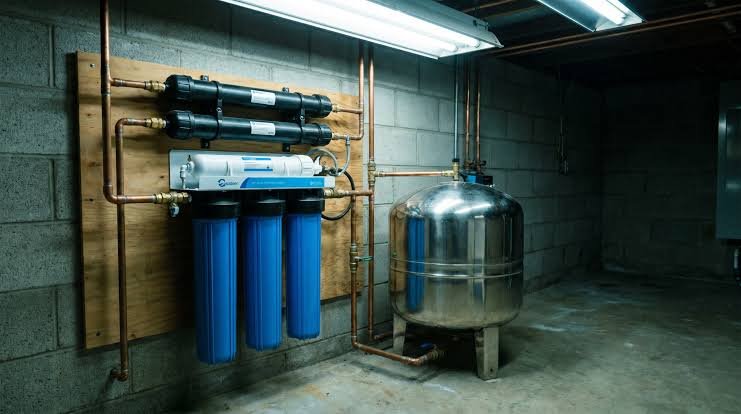
This is where systems combining softeners & reverse osmosis can become useful. A softener can address hardness throughout the home, while reverse osmosis is generally used at a specific drinking-water location for more intensive purification.
The two technologies do different jobs. That distinction matters.
What Reverse Osmosis Actually Does
Reverse osmosis, often shortened to RO, uses a semipermeable membrane to reduce many dissolved substances from water. It’s commonly installed under a kitchen sink or at another point where drinking and cooking water is needed.
A properly designed reverse osmosis water filtration system can help reduce certain dissolved contaminants, depending on the membrane, prefilters, and overall system design.
RO systems typically use several stages. Sediment filtration may come first to protect the system from particles. Carbon filtration can help reduce chlorine and improve taste. Then the RO membrane performs the main separation process.
Some systems include a final polishing filter or remineralization stage as well.
One thing to remember: reverse osmosis isn’t automatically the right answer for every household. If the main issue is hard water throughout the house, installing RO alone won’t solve it. That’s like using a coffee strainer to fix a leaky pipe. Different problem, different tool.
Think About What Happens Beyond the Kitchen
Water quality affects more than drinking water.
Hard water, for example, can leave deposits on showerheads and faucets. Chlorinated water may have a noticeable smell. Sediment can collect in fixtures and appliances. Depending on local conditions, other contaminants may also deserve attention.
That’s why many homeowners choose to divide treatment into two levels: whole-home treatment for general water quality and point-of-use purification for drinking water.
This approach can be more efficient than trying to make every gallon in the house meet drinking-water standards through an intensive purification process.
It also gives homeowners more flexibility when choosing equipment.
Maintenance Is Part of the Deal
Even the best water treatment system needs maintenance. Filters eventually become loaded with the material they were designed to remove. RO membranes have a useful service life. Water softeners may need salt or other maintenance depending on their design.
Ignoring maintenance can reduce performance and, in some cases, create new water-quality concerns.
A simple maintenance schedule should include checking filters, replacing cartridges when recommended, inspecting connections, and following the manufacturer’s service instructions.
If your system has been running for years without anyone looking at it, don’t assume it’s still working exactly as intended. Water treatment equipment isn’t a set-it-and-forget-it appliance.
Don’t Choose a System Based on Marketing Alone
Water treatment is full of impressive-sounding claims. “Pure,” “advanced,” and “maximum protection” can look great on a brochure, but those words don’t tell you much by themselves.
Instead, look for specific information about what a system is designed to reduce and whether those claims are supported by credible testing or certification.
It’s also worth considering flow rate, installation requirements, filter replacement costs, wastewater production for RO systems, available space, and long-term operating expenses.
The cheapest system may not be the cheapest system to own.
Likewise, the most complicated setup isn’t necessarily the best one. Good water treatment is about matching the technology to the actual water problem.
A Smarter Way to Improve Your Water
There’s no universal water treatment system that works perfectly for every household. The right choice depends on your source water, household size, plumbing setup, budget, and—most importantly—the contaminants or minerals you want to address.
Start with testing. Identify the problem. Then compare technologies based on what they actually do.
For some homes, a whole-house filter may be enough. Others may benefit from a softener, while households concerned about drinking-water quality may prefer an RO system at the kitchen sink. In certain cases, combining technologies makes the most sense.
The goal isn’t to make your water sound fancy on paper. It’s to make the water coming out of your taps cleaner, more pleasant, and better suited to your everyday needs.
And honestly, that’s what good water treatment should be about: solving a real household problem without making the solution more complicated than it needs to be.